Three Verticals
Eval-driven development helps any agentic product in three places. I keep them separate so a number from one does not answer a question from another.
- Release readiness. Offline, before a release. An eval run produces a quality report. That report is how I decide the harness is ready to ship.
- Production monitoring. Online, continuous. The same suites on sampled live traces. Drift, a regression, an incident — within hours, not after a ticket.
- Model selection. The same suites, the same fixtures, candidate models side by side. Quality sits next to cost and latency. I do not select a model from a demo.
None of that is a new runner. It is the same cases, on a different schedule.
One Platform
One eval platform. Online and offline both read fixtures in code. A case is a history, a persona, and a scenario. A persona is the profile the questions reuse. A scenario is this session’s clock and the facts the mocks must return. History is the turns already on the thread.
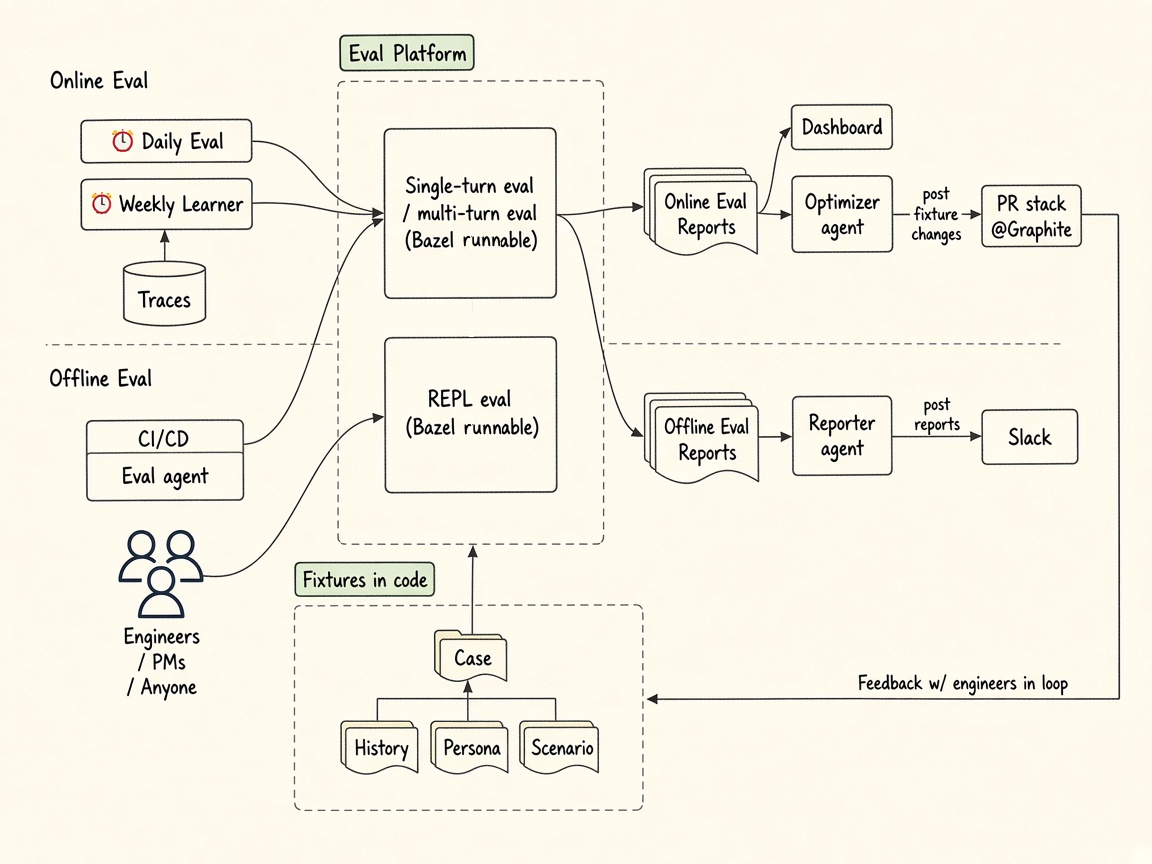
Online starts from a daily eval and a weekly learner over production traces.
Daily, single-turn and multi-turn runs write online reports and publish them to the production dashboards from Part 3.
Weekly, an optimizer agent turns a miss into a fixture change and opens a PR stack. The sampler never writes a customer into git. That constraint runs on a schedule. The diff can be a case, a scorer, or the environment the case runs in. A person still merges it.
The Onion
The eval stack is an onion.
The core is a guardrail check. Small. Deterministic. Fast to diagnose. Each layer outward allows more randomness, and it needs more signals to stay reliable. The outer layer tests complete behavior and the UX. Starting there spends the review on the wording of one paragraph.
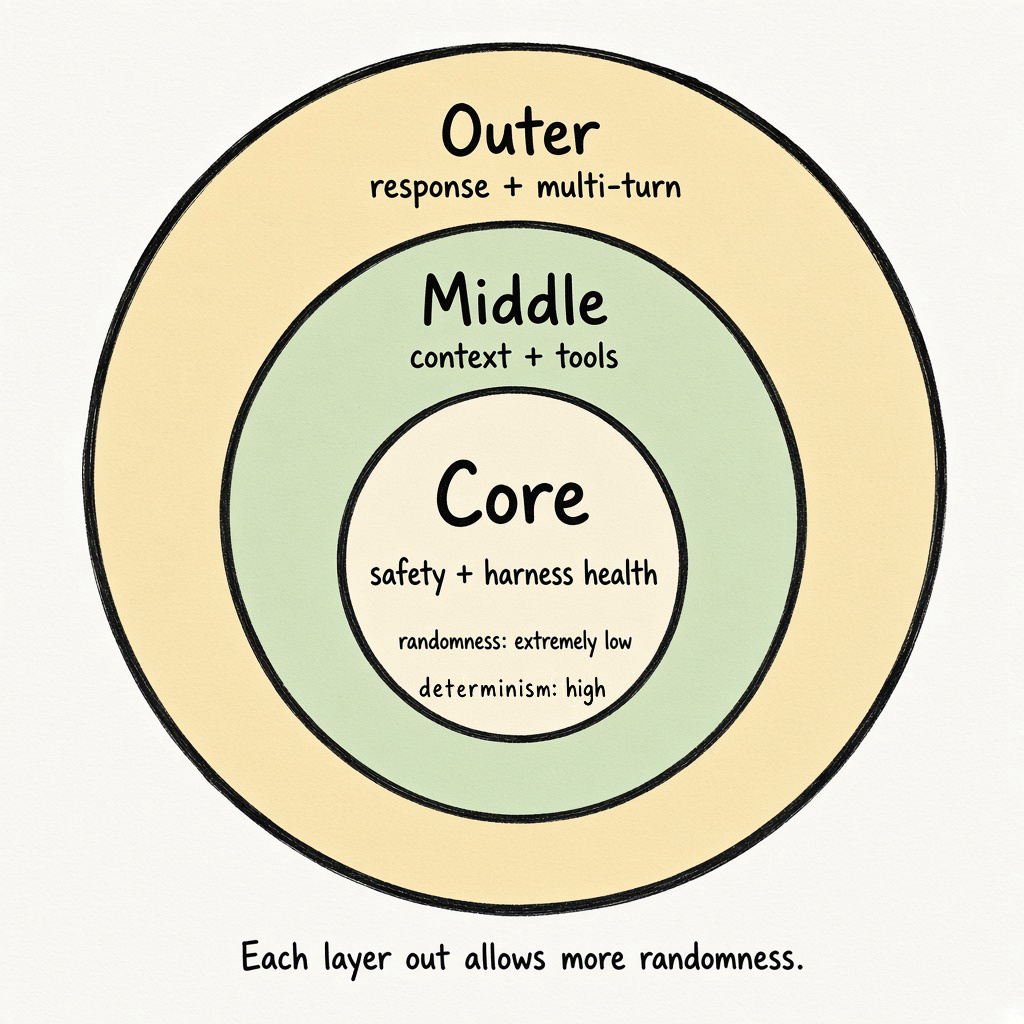
Here is my framework.
| Layer | Verticals / domains | Randomness | Extra signals |
|---|---|---|---|
| Core |
Safety
Harness health
|
Extremely low. |
Zero to low. Potentially:
|
| Middle |
Context engineering
Relevancy and safety test
|
Moderate. |
Everything from the inner layer.
The middle and the outer layer both start to need a lot of domain knowledge. |
| Outer |
Response examination
Multi-turn analysis
|
High |
Everything from the layers above.
A lot of domain knowledge here too. |
Poisoning, distraction, confusion, and clash follow IBM Technology’s walkthrough of context failure modes.
Two ways to run it.
Offline. Fast iteration. The only dependency is LLM access, no matter how many upstream services hide behind function tools or MCP.
Online. Daily. Sample production traces. Loop a human into QA.
Shared Building Blocks
A case points at one history, one persona, one scenario. The product selects the suite. Offline, the tree looks like this. The example is one subscription. Its statement has posted on the 3rd of each month for eight months.
eval/offline/fixtures
├── cases/
│   ├── product_1/
│   │   └── subscription_statement.yaml
│   └── red-team-100.yaml
├── history/
│   └── talk_to_agent.yaml
├── personas/
│   └── research_subscriber.yaml
└── scenarios/
    ├── general.yaml
    └── subscription_eight_months.yaml
Case. The question under test. query is the user turn. History, the persona preset, and the scenario are names, not copies. Tags are a list. Scorers still compose per case, as they do in the gym. The scorer schema is unchanged from Part 3.
- id: subscription_statement
  query: Did the subscription statement post?
  history: talk_to_agent
  persona_preset: research_subscriber
  scenario: subscription_eight_months
  tags: [subscription]
History. Turns already on the thread. Role and content. Tool traces are separate, and that split is in Part 2. The file is the thread the tester starts from.
- role: user
  content: I want to know if a subscription statement posted.
- role: assistant
  content: I can look. Which subscription?
Persona. Who the customer is. Timezone, identity, features such as crypto, options, and margin, the accounts they hold. It changes slowly. Many questions reuse it. A persona is a profile, not a person. This one holds a brokerage account and a cash account, and does not trade options.
name: research_subscriber
timezone: America/Los_Angeles
identity:
  full_name: Morgan Ellis
  email: morgan.ellis@example.com
  account_number: "481920337"
  state: WA
features:
  crypto:
    status: disabled
  options:
    status: disabled
  margin:
    status: disabled
accounts:
  - account_number: "b77k12004"
    account_type: brokerage_individual
    nick_name: Long Book
    is_default: true
    cash: 4200.0
  - account_number: "c12m88301"
    account_type: cash
    nick_name: Spending
    is_default: false
    cash: 860.0
Scenario. The situation for this session, bound to one persona. It carries the clock and the story. The facts are the contract. Any number or state the assistant might quote belongs here, and the mocked backends must return it. A fact in this file is a latch. The synthesizer is not allowed to contradict it.
Eight statements. March 3 through October 3, 2026. Same merchant, same amount, the cash account, no skipped month. The clock is October 14. November has not come due.
name: subscription_eight_months
clock: "2026-10-14T09:30:00-07:00"
story: >
  Research Desk bills 29.00 USD on the 3rd of each month from the cash
  account. Eight statements have posted, March 3 through October 3, 2026.
  No month was skipped. No other subscription statement exists.
facts:
  statements:
    - kind: subscription_statement
      merchant: Research Desk
      amount: 29.00
      currency: USD
      account: cash
      posted_on:
        - "2026-03-03"
        - "2026-04-03"
        - "2026-05-03"
        - "2026-06-03"
        - "2026-07-03"
        - "2026-08-03"
        - "2026-09-03"
        - "2026-10-03"
Morgan Ellis does not exist. The eight statements did not happen. The pattern — a subscription posts on the same day, for the same amount, for eight months — is what the fixture keeps.
How You Run It
Single-turn Eval
Offline, one fixture:
just eval --env offline --product <product> --fixtures <single_turn_fixture>Multi-turn Eval
The same command, with a different fixture. A tester agent plays the user. A policy keeps the tester on the scenario. The eval then grades the context the two of them produced.
context = tester_agent(agent_under_test, policy())
report = eval(context)
just eval --env offline --product <product> --fixtures <multi_turns_fixture>Interactive Eval (REPL)
The same blocks. I type the user turns. One session is below. The URIs stay redacted.
$ just eval-repl --history=<history> --persona=<persona> --scenario=<scenario> --product=<product>
> hi
user: hi
assistant: Hi, how could I help you?
> Read my tax lots for what I could sell long terms?
assistant: On it
[heartbeat]
[heartbeat]
assistant: Here is the table with all valid long terms holdings
[table] col:6,rows:21
assistant: and here is a visual of your holdings's performance
[assets_chart] uri=<redacted>
> K, I want customer support
assistant: Can you specify the issue so I could help?
> No need, just connect me to support
assistant: On it, let me forward to you our support.
[in_app_destination] uri=<redacted>
The heartbeat shows the harness is still in the loop. The table and the chart are widgets, not additional prose. The last turn is an in-app destination. That is the outer-layer structure check in the onion: the navigation link has a destination.
Engineers contribute cases. Engineers contribute scorers. The runner treats those files the same regardless of author. A harness change — a tool, a packing of the window, a skill — gets a case in the same PR, and the core is the first signal. Tokens, cache rate, TTFT, TTFB, duration, steps, tool count. I do not wait for a sentiment trajectory to report that the prefix doubled.
The CLI is the offline run. The daily job is the online cron. The weekly agent proposes the next fixture. I still merge it.
Next
That is the loop. Offline while I am making the change. Daily once the harness is in production. Weekly when a miss should become a fixture.
Next is Part 6 — a persisted workflow plan. A skill names the tools. The record holds the DAG and the current step.
The onion stays fast only while the core stays small.