Question - post
Given a 2D binary matrix filled with 0’s and 1’s, find the largest rectangle containing all ones and return its area.
Example 1:
["10100",
 "10111",
 "11111",
 "10010"
Return 6
Example 2:
["101111",
 "011111",
 "011011",
 "001111",
 "101100"]
Return 8
Example 3:
["1111",
 "1111",
 "1111"
Return 12
Solution - code
Given a navigation that goes through the elements from the left-top one to the right-bottom one, we need to know at a specific element, what is the certain information that defines the maximal rectangle from the previous left or top elements. In terms of this mentor model, the problem is essentially a Dynamic Programming (wiki) problem. So the point is …
- To define the smallest subproblem so that we could break the problem into smallest subproblems.
- Use memorization to store the results of the solved subproblems.
The smallest subproblem is that: For every row of the array, it is a “Largest Rectangle in Histogram” problem.
Step 1 - Subproblem “Largest Rectangle in Histogram”
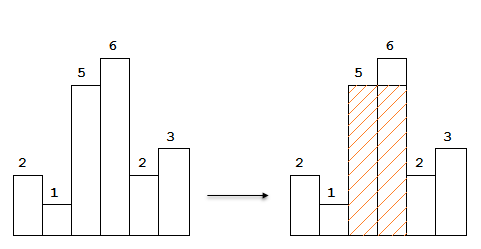
For every element, we go through the elements behind. The code is like,
def maximalRectangleInHistogram(self, histogram):
    """
    Calculate the maximum rectangle area in terms of a given histogram.
    (Ver.1)
    :param histogram: List[int]
    :return:  int
    """
    maxArea = 0
    size = len(histogram)
    # For every bar in the histogram, we go through the previous bars.
    for i in range(size):
        # Take current height as the minimum height.
        minH = histogram[i]
        for j in reversed(range(i)):
            # Return if it meets zero.
            if histogram[j] == 0:
                break
            # Find the minimum height at the moment.
            minH = min(minH, histogram[j])
            # Calculate the area at the moment.
            area = minH * (i - j + 1)
            # Find out the maximum area.
            maxArea = max(maxArea, area)
    return maxArea
Can we do this better? Sure! We could try to use stack coming with certain rules to improve the back navigation. So the problem becomes when to push and when to pop. I still don’t figure out the way to improve the previous version and it’s the code from the internet:
def maximalRectangleInHistogram(self, histogram):
    """
    Calculate the maximum rectangle area in terms of a given histogram.
    (Ver.2)
    :param histogram: List[int]
    :return:  int
    """
    # Stack for storing the index.
    posStack = []
    i = 0
    maxArea = 0
    while i < len(histogram):
        if len(posStack) == 0 or histogram[i] > histogram[posStack[-1]]:
            # Advance the index when either the stack is empty or the
            # current height is greater than the top one of the stack.
            posStack.append(i)
            i += 1
        else:
            curr = posStack.pop()
            width = i if len(posStack) == 0\
                else i - posStack[-1] - 1
            maxArea = max(maxArea, width * histogram[curr])
    # Clean the stack.
    while posStack:
        curr = posStack.pop()
        width = i if len(posStack) == 0\
            else len(histogram) - posStack[-1] - 1
        maxArea = max(maxArea, width * histogram[curr])
    return maxArea
Step 2 - Break The Problem Into Subproblems
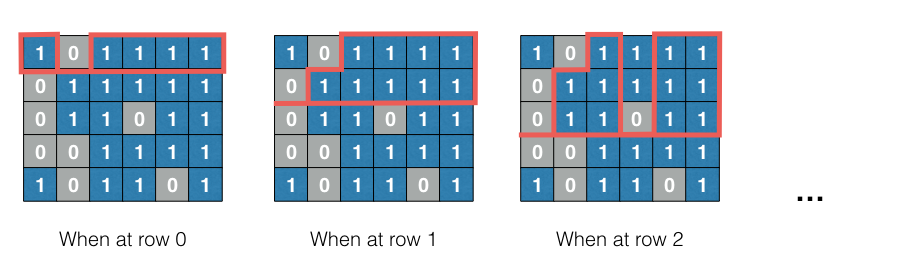
For every row of the array, it is a “Largest Rectangle in Histogram” problem and the code is like,
class Solution(object):
    def maximalRectangle(self, matrix):
        """
        :type matrix: List[List[str]]
        :rtype: int
        """
        if not matrix:
            return 0
        maxArea = 0
        maxRow = len(matrix)
        maxCol = len(matrix[0])
        # For every row in the given 2D matrix, it is a "Largest Rectangle in
        # Histogram" problem, which is the subproblem.
        lookupTable = [0 for _ in range(maxCol)]
        for row in range(maxRow):
            for col in range(maxCol):
                # If it is "1"
                if int(matrix[row][col]) > 0:
                    # Accumulate the column if if's 1's.
                    lookupTable[col] += int(matrix[row][col])
                else:
                    # Clean the column if it's 0's.
                    lookupTable[col] = 0
            # Calculate the maximum area.
            maxArea = max(maxArea,
                          self.maximalRectangleInHistogram(lookupTable))
        return maxArea
Reference:
Application Sample
- To find the largest closing rectangle from a given thresholding image.