I recently am asked with this pseduo code for concurrent programming problem:
Given the following code, tell me what is the possible range of value for global?
int global = 0;void t() { for (int i = 0; i < 5; i++) global++;}main() { for (int i = 0; i < 5; i++) thread_run(t);}The answer is from 2 to 25!
Explained
To solve this problem, you have to be aware of that global is NOT an atomic variable nor protected by any lock.
From there, the ++global are basically three atomic operation in sequence:
- Read value from memory to CPU register
- Increment value of the CPU register
- Write CPU register to memory
So the inconsistency could happen in between READ and WRITE.
Upper bound explained
The most happy result would be that the 5 threads execute in sequence, illustrated in the diagram below:
flowchart LR
  t1[Thread 1] --> t2[Thread 2] --> t3[Thread 3] --> t4[Thread 4] --> t5[Thread 5]
  t5 --> result["global = 25"]
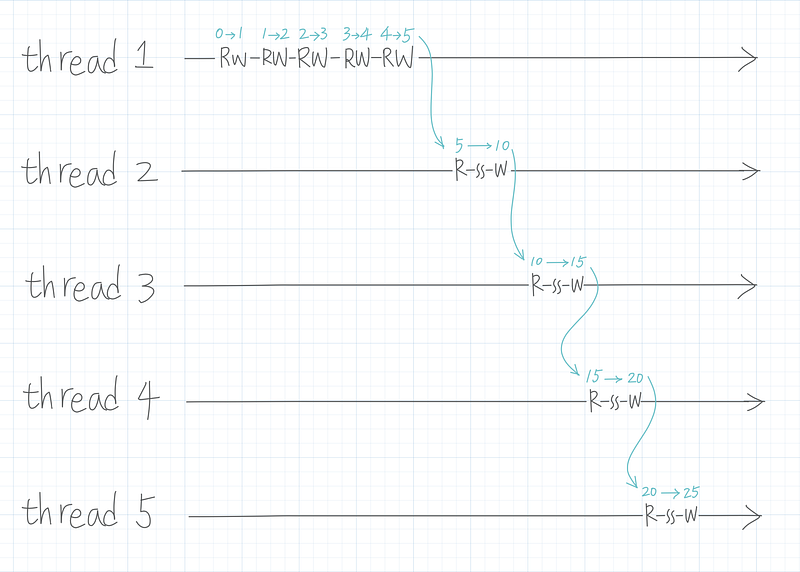
You could shuffle the order of threads and the result would be the same.
Lower bound explained
What if threads race against each other?
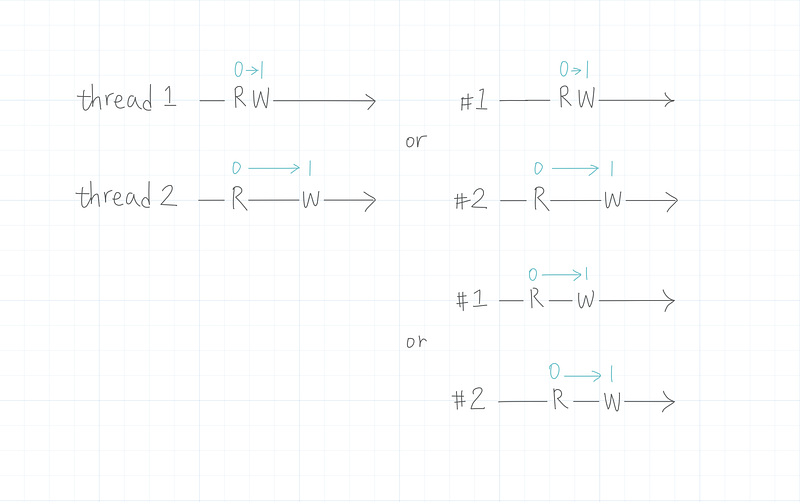
To answer that, let’s start with simpler problem: Two threads and no loop.
int global = 0;void t() { global++;}main() { for (int i = 0; i < 2; i++) thread_run(t);}As illustrated below, you see that global could end up 1 because one thread reads the old value for increment operation.
Then we slightly add more complexity in order to approach the problem closer to the original one: keep two threads but have two global++ in each thread.
int global = 0;void t() { for (int i = 0; i < 2; i++) global++;}main() { for (int i = 0; i < 5; i++) thread_run(t);}Again as illustrated below, thread #1 ’s last increment happens to override the other thread’s whatever operation to global.
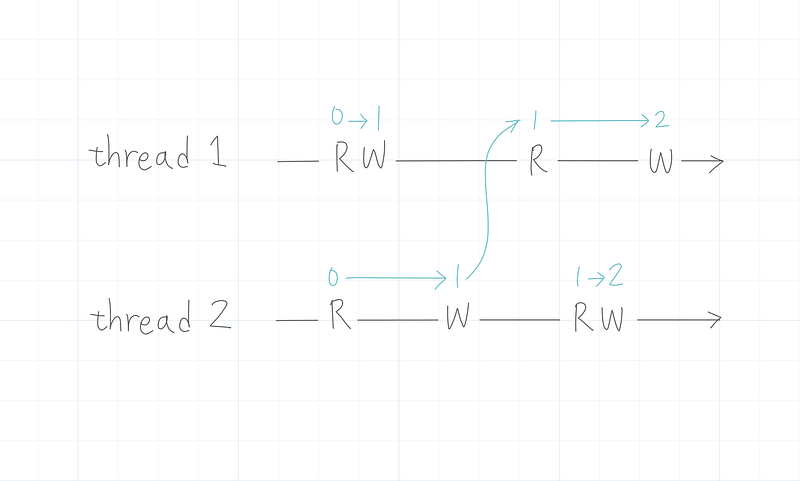
Actually, N times of global++ and two global++ result the same! It is because this thread’s last increment could read the very old value, 1, and write 2 as the last operation among the threads.
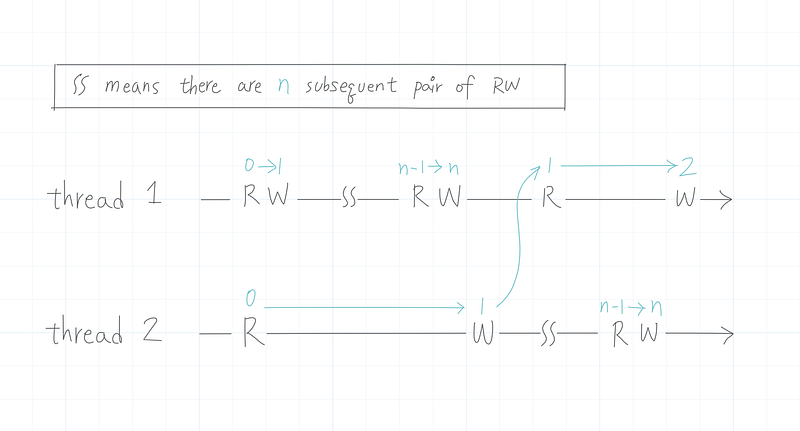
Even you increase threads from two to five, or even larger number. The race condition could end up with the same result, which gives us the lower bond of the possible value of global as always 2.
I hope this would help you in your software engineering career. Please don’t hesitate to leave likes and that will encourage me to continue writing more interesting insights along the course.