The blog post refers to RxJava 2.1.13
Updated on 2018 Apr 30 — Change title to “reactive destruction… ”
I guess many of you are already using libraries like RxBinding (by Jake Wharton) and you might be familiar with the code snippet as below:
// Whatever Activity

private val mDisposables = CompositeDisposable()
private val mBtnFoo by lazy { findViewById<View>(R.id.foo) }

override fun onResume() {
    mDisposables.add(
        RxView.click(mBtnFoo)
              .subscribe {
                  println("oh click on Foo")
              })
}

override fun onPause() {
    mDisposables.clear()
}
For those who are not familiar with RxJava and RxBinding, the code above registers an OnClickListener in the onResume() and that listener is implicitly unregistered in the onPause(). That leads to an interesting question, which is
How does the callback magically get recycled with only one simple line, mDisposables.clear()?
That is the power of the custom Observable and I call it the reactive destruction. To know how to use it, let us look into RxView.click() function:
public static Observable<Object> clicks(View view) {
    return new ViewClickObservable(view);
}
Oh, so it returns a ViewClickObservable, and what is it?
final class ViewClickObservable extends Observable<Object> {
    private final View view;

    ViewClickObservable(View view) {
        this.view = view;
    }

    @Override
    protected void subscribeActual(Observer<? super Object> observer) {
        Listener listener = new Listener(view);

        // Most importantly, pass the observer a Disposable
        observer.onSubscribe(listener);

        view.setOnClickListener(listener);
    }

    static final class Listener extends MainThreadDisposable
                                implements OnClickListener {
        private final View view;

        Listener(View view, Observer<? super Object> observer) {
            this.view = view;
        }

        @Override
        protected void onDispose() {
            view.setOnClickListener(null);
        }
    }
}
When there is an observer subscribes to this observable, the subscribeActual gets called. In the subscribeActual function, it creates a Disposable and passes the Disposable to the observer. By doing so, the observable gives the observer the power of shutting down the source signal. When the observer decides not to receive any signal sending from the observable, it calls dispose(). In this case, the dispose() unregisters the onClickListener.
Let us take a look of the first code snippet again:
// Whatever Activity

private val mDisposables = CompositeDisposable()
private val mBtnFoo by lazy { findViewById<View>(R.id.foo) }

override fun onResume() {
    mDisposables.add(
        RxView.click(mBtnFoo)
              .subscribe {
                  println("oh click on Foo")
              })
}

override fun onPause() {
    mDisposables.clear()
}
The Disposable is like the voucher representing a reactive stream graph; CompositeDisposable is like a drawer in which you could put all the vouchers, and clear() is to dispose every single disposable from the collection.
With the help of Observable, we could build custom Observable encapsulating some operation that allocates some resources when someone subscribes to it and release that resources automatically when no one is interested of it.
That really makes the code neat and reactive!
Custom Single
The code snippet of custom Single is very similar to custom Observable except the observer is SingleObserver.
class FooSingle : Single<Boolean>() {

    override fun subscribeActual(observer: SingleObserver<in Boolean>) {
        val d = FooDisposable(mWidget)
        observer.onSubscribe(d)

        try {
            // Allocate memory or register listeners...

            // Tell the observer the sole result
            observer.onSuccess(true)
        } catch (err: Throwable) {
            observer.onError(err)
        }
    }

    internal class FooDisposable : Disposable {

        @Volatile
        private var disposed = false

        override fun isDisposed(): Boolean {
            return disposed
        }

        override fun dispose() {
            disposed = true

            // Release the memory or unregister the listeners...
        }
    }
}
The difference between Observable and Single is the number of sent values, where Observable emits values over time as opposed to Single emits single value or error.
In many cases like network, the async task gives us single result, in essence, Single fits the needs better. In the following figure, there is a cross at the end of the stream indicating this source gets nothing to send, and source calls observer’s onComplete. So Single implicitly finishes its observers!
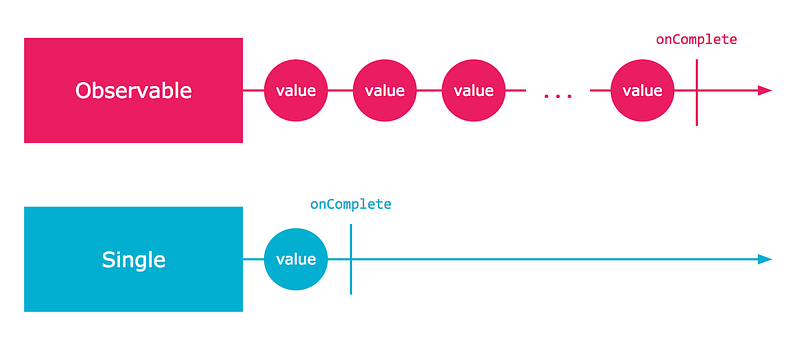
Indeed, the onComplete might cause your custom disposable’s dispose() not properly called. That depends on what observer you attach to the source. Usually, we call subscribe() and that attaches a ConsumeSingleObserver to the upstream. Let’s look into this particular observer:
public final class ConsumerSingleObserver<T>
    extends AtomicReference<Disposable>
    implements SingleObserver<T>,
               Disposable,
               LambdaConsumerIntrospection {

    // ...

    @Override
    public void onSubscribe(Disposable d) {
        DisposableHelper.setOnce(this, d);
    }

    @Override
    public void onSuccess(T value) {
        lazySet(DisposableHelper.DISPOSED);
        try {
            onSuccess.accept(value);
        } catch (Throwable ex) {
            // ...
        }
    }

    @Override
    public void dispose() {
        DisposableHelper.dispose(this);
    }

    // ...
}
In the sample, the observer is SingleObserver also a Disposable. As an observer, onSubscribe() is called when this observer subscribes to an observable. So in onSubscribe(), you need to keep the given disposable and use it to destroy the source chain later.
The onSuccess() is called when receiving the signal. Look carefully into onSuccess(); it replaces the given disposable with a static dummy disposable. Which means this special ConsumerSingleObserver implicitly blind itself once it gets value, and that is why your disposable’s dispose() won’t be called in the end. Actually, the LambdaObserver (used by Observable’s subscribe()) do so in onComplete() too.
public final class LambdaObserver<T>
    extends AtomicReference<Disposable>
    implements Observer<T>,
               Disposable,
               LambdaConsumerIntrospection {

    // ...

    @Override
    public void onComplete() {
        if (!isDisposed()) {
            lazySet(DisposableHelper.DISPOSED);
            try {
                onComplete.run();
            } catch (Throwable e) {
                // ...
            }
        }
    }

    // ...
}
Not all the observers behave like so, for example, the test() observer always keeps the given disposable, and guarantees the disposable’s dispose() to trigger.
A Concrete Example
I want to establish a binding in between my Widget component and the observable Model component. The binding would be destroyed by merely calling the disposable’s dispose(). Thus, I utilize the custom Observable as below:
class BindWidgetWithModel<T>(widget: IWidget<T>,
                             model: T,
                             caughtErrorSignal: Observer<Throwable>? = null)
    : Observable<Boolean>() {

    private val mWidget = widget
    private val mModel = model

    private val mCaughtErrorSignal = caughtErrorSignal

    override fun subscribeActual(observer: Observer<in Boolean>) {
        val d = UnbindDisposable(mWidget, mCaughtErrorSignal)
        observer.onSubscribe(d)

        if (!d.isDisposed) {
            try {
                mWidget.bindModel(mModel)

                observer.onNext(true)
            } catch (err: Throwable) {
                observer.onNext(false)

                mCaughtErrorSignal?.onNext(err)
            }
        }
    }

    internal class UnbindDisposable<T>(widget: IWidget<T>,
                                       caughtErrorSignal: Observer<Throwable>?)
        : Disposable {

        @Volatile
        private var disposed = false

        private val widget = widget
        private val caughtErrorSignal = caughtErrorSignal

        override fun isDisposed(): Boolean {
            return disposed
        }

        override fun dispose() {
            disposed = true

            try {
                widget.unbindModel()
            } catch (err: Throwable) {
                caughtErrorSignal?.onNext(err)
            }
        }
    }
}

// Separate file
interface IWidget<in T> {

    fun bindModel(model: T)

    fun unbindModel()
}
See, I don’t call onComplete() here.
Conclusion
Some people only use RxJava as an async task framework, like defer-promise. Actually RxJava is more than that, and there is a learning curve for using RxJava correctly because the details hide both in the observables and observers. In general, for observers, onComplete() is like a terminal signal, and that is likely to blind the reactive stream from calling your disposable’s dispose().
There is still a simple rule, use custom Observable and don’t call onComplete() when you want to build a reactive source which will destruct itself when disposed. As opposed to custom Single is for one-time task and should release the memory or listeners right after onSuccess() call rather than dispose().
Lastly, reactive destruction is also important to the system design where it minimizes the lines of ambiguous code that hides the real intent.
Thanks for reading. If you think this post is helpful, please don’t hesitate to give the claps. Or if you found some mistakes I made, feel free to drop a note here. ✨